
Heat Pump vs Condenser Tumble Dryer: Which Should You Choose?
Use this guide if you are deciding between a heat pump dryer and a condenser dryer. The right choice usually comes down to upfront budget, running costs, usage frequency and how long you expect to keep the machine.
In simple terms, heat pump dryers usually make more sense for regular use and lower running costs. Condenser dryers can still make sense when the main priority is a lower purchase price.
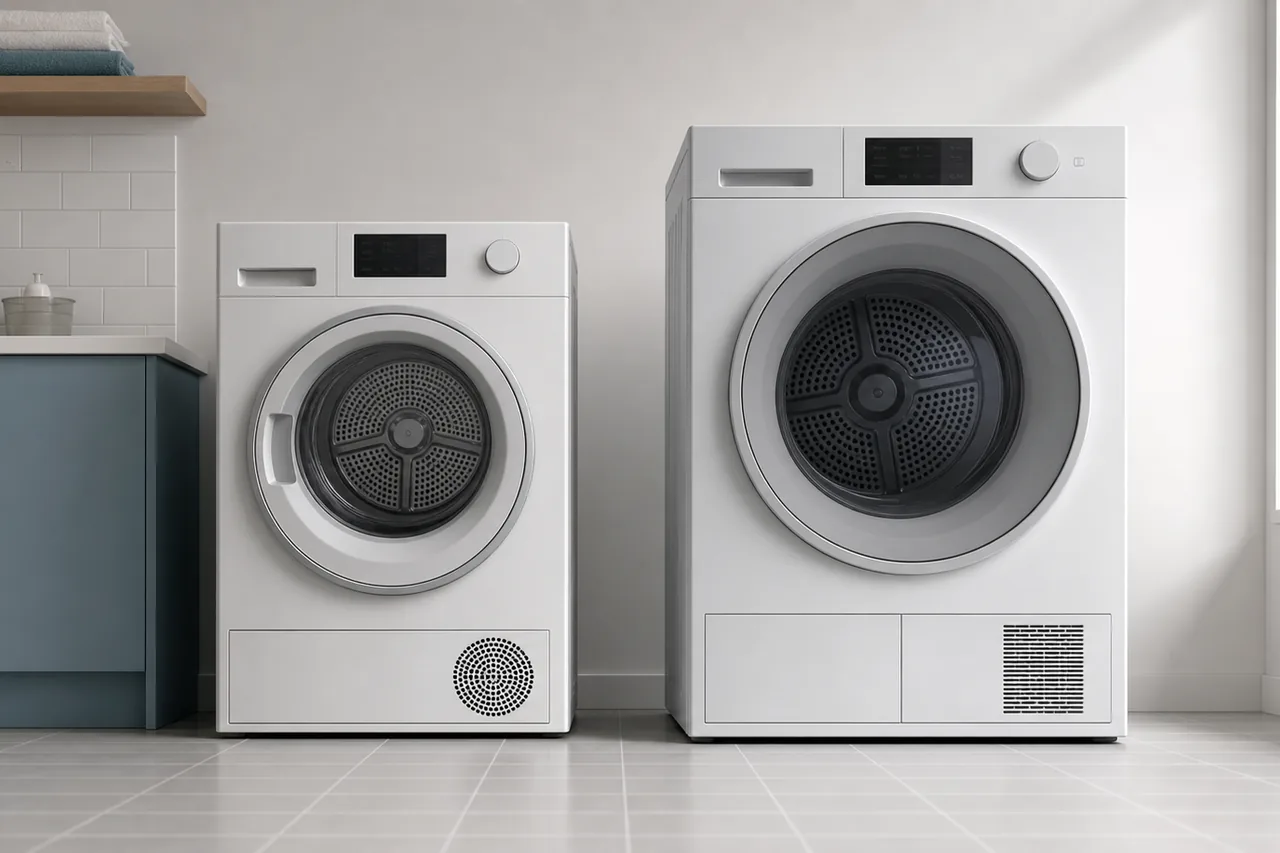
Choose the dryer type first, then compare shortlists
If you already know you want the lowest running cost route, go to the best heat pump tumble dryers. If you mainly want lower upfront spend, start with cheap tumble dryers. If you want to compare ownership cost, use the running cost calculator.
Heat pump vs condenser: which one is better?
A heat pump dryer is usually the better long-term choice if you dry clothes regularly and care about lower running costs over time. A condenser dryer can still be the better buy if the main priority is keeping the upfront price lower and the dryer will not be used heavily every week.
Choose heat pump if
You expect regular weekly use and want a stronger long-term value case.
Choose condenser if
You need a lower purchase price now and the machine will not be used heavily enough for savings to matter as much.
Best for family use
Heat pump usually becomes the stronger route when laundry is frequent and ongoing cost matters.
Best for tight budgets
Condenser is often easier to justify when the buying decision is mainly about reducing the initial spend.
What is the real decision here?
For most buyers, this is not really a brand decision first. It is a choice between paying more now for lower running costs later, or paying less now and accepting a weaker long-term efficiency case.
Heat pump or condenser dryer: the short answer
Choose a heat pump dryer if you dry clothes regularly and want lower running costs over time. Choose a condenser dryer if you want a lower upfront price, easier placement than a vented dryer and simpler short-term buying logic. If you are comparing clothes dryer heat pump vs condenser results, the real decision is usually running cost versus upfront price.
Heat pump wins when
You dry several loads per week, expect to keep the machine for years and want better long-term energy logic.
Condenser wins when
You dry lightly, need flexible placement and want to keep the purchase price lower.
Heat pump vs condenser at a glance
This is the fastest way to compare the two main dryer types before you spend time looking at individual models.
Better for regular use and lower running costs
Upfront price
Usually higher
Running costs
Usually lower over time
Drying style
Often gentler and more efficiency-led
Best for
Regular use and longer-term ownership
Who should start here?
Family homes, regular use and efficiency-focused buyers
Main drawback
Higher day-one spend
Better for lower upfront spend and lighter use
Upfront price
Usually lower
Running costs
Usually higher over time
Drying style
Often simpler and budget-led
Best for
Tighter budgets and lower day-one spend
Who should start here?
Price-first buyers and lighter-use homes
Main drawback
Higher ongoing cost over time
Quick decision table: heat pump or condenser?
Use this simple table if you want the cleanest answer before choosing a model.
| Buying priority | Better route | Why |
|---|---|---|
| Lowest upfront price | Condenser | Usually cheaper to buy than a heat pump dryer. |
| Lower running cost | Heat pump | Usually uses less electricity over time. |
| Regular family use | Heat pump | The more you dry, the more efficiency tends to matter. |
| Occasional use | Condenser | Lower upfront cost may matter more if usage is light. |
| Long-term ownership | Heat pump | Lower running costs can become more important over several years. |
| Tight budget today | Condenser | Often easier to justify when checkout price is the main limit. |
Which type makes sense for your home?
Use the route below that matches how you actually expect to use the dryer.
Heat pump usually makes more sense if…
You dry clothes regularly, expect to keep the machine for longer and care about reducing running cost over time.
Condenser usually makes more sense if…
You need to keep the purchase price lower and the dryer will not be used heavily enough for long-term savings to become the bigger factor.
Heat pump is often better for
Family homes, frequent laundry routines, regular weekly drying and buyers thinking beyond checkout price.
Condenser is often better for
Lower upfront budgets, lighter use and homes where day-one spend matters more than long-term efficiency.
Best route by usage level
These are the most common real-world situations where one route becomes easier to justify than the other.
Light use
1–2 loads per week
Often sensible: condenser
Lower upfront price may matter more when the dryer is only used occasionally.
Average use
3–5 loads per week
Compare carefully: heat pump vs condenser
This is where running cost starts to matter more, especially if you expect to keep the dryer for years.
Heavy use
6+ loads per week
Often sensible: heat pump
The more often you dry laundry, the stronger the heat pump running cost case usually becomes.
Why running cost matters so much
This comparison becomes much clearer once you look at ownership cost, not just purchase price. For light use, the difference may matter less. For regular weekly use, it often becomes one of the biggest reasons to choose heat pump.
Best next check
Use the running cost page if you want to see what the difference can look like over time in real household use.
What matters most in the decision
Usage frequency
The more often the dryer is used, the stronger the heat pump case usually becomes.
Upfront price
Condenser often makes more sense if the buying decision is mainly about reducing the initial spend.
Ownership logic
Think beyond checkout price and ask what the dryer is likely to cost over time in your home.
Buyer fit
The best route depends more on your usage pattern than on a generic idea of what is “best”.
Built for buyers who want the type decision first
This page is designed for UK buyers who are still deciding between the two main dryer types and want a cleaner decision before comparing individual models.
- Shoppers comparing lower running costs versus lower purchase price
- Homes deciding whether a heat pump upgrade makes sense
- Buyers narrowing the choice before building a shortlist
- People who want a simpler decision with less filler and less noise
How this comparison is built
This guide compares heat pump and condenser tumble dryers by practical buyer fit: upfront cost, running cost logic, likely usage pattern, household need and long-term ownership priorities.
It is designed as a type decision guide, not a model ranking. Once you know which type suits your home, move to the relevant shortlist.
Where to go after this comparison
Once you know which type makes more sense, move to the guide that matches that route.
Best Tumble Dryers
Use this if you want the strongest all-round shortlist after deciding your route.
Best Heat Pump Tumble Dryers
Use this if lower running costs and regular use point you clearly towards heat pump.
Cheap Tumble Dryers
Use this if the budget-first route still makes more sense for your home.
Tumble Dryer Running Costs
Use this if you want to estimate cost per load, per month and per year.
Drying time: heat pump vs condenser
Drying time is one of the biggest real-world differences between heat pump and condenser tumble dryers. A heat pump dryer usually uses less electricity, but it can take longer to dry a full load. A condenser dryer often dries faster, but normally uses more energy per cycle.
For many UK homes, the better choice depends on what matters more: lower running cost or faster drying. If you dry several loads every week and can wait longer for each cycle, heat pump usually makes more sense. If you need faster turnaround and only use the dryer occasionally, a condenser dryer can still be practical.
| Question | Heat pump dryer | Condenser dryer |
|---|---|---|
| Usually cheaper to run? | Yes, especially with regular use | No, normally higher electricity use |
| Usually faster? | Often slower | Often faster |
| Best for frequent drying? | Usually yes | Only if speed matters more than cost |
| Best for occasional use? | Can be good, but higher upfront price matters | Often acceptable for light use |
Which is better for flats and small homes?
For flats, maisonettes and small UK homes, both heat pump and condenser dryers can work because neither usually needs an external vent hose in the same way as a vented dryer. The bigger question is heat, moisture management, noise, space and how often the dryer will be used.
A heat pump dryer can be attractive in flats because it is usually more energy efficient and gives off less wasted heat. A condenser dryer can still suit a flat if the budget is tighter, but the room should be suitable and the water container, filter and condenser unit need regular maintenance.
Flat buyer checklist
- Check the dryer dimensions and door clearance before buying.
- Make sure the room has enough airflow around the appliance.
- Check whether the water tank is easy to empty.
- Look at noise level if the dryer will be near a bedroom or living area.
- For frequent use, compare running cost before choosing the cheapest upfront model.
Best choice by buyer type
There is no single best tumble dryer type for every home. The right answer depends on usage, budget, space and whether you care more about long-term running cost or lower upfront price.
| Buyer type | Usually better choice | Why |
|---|---|---|
| Family drying several loads a week | Heat pump | Lower running cost matters more over time |
| Occasional dryer user | Condenser or budget heat pump | Upfront price may matter more than annual saving |
| Flat or small home | Heat pump if budget allows | Efficient, practical and often better for regular use |
| Buyer who needs faster cycles | Condenser | Often faster, but usually less efficient |
| Buyer focused on long-term value | Heat pump | Higher upfront price can be offset by lower running cost |
Short answers before you move on
Is a heat pump dryer usually better than a condenser dryer?
Usually for regular use, yes. The stronger case is lower running costs over time, even though the upfront price is usually higher.
Is a condenser dryer cheaper to buy?
Usually yes. That is why condenser models can still make sense when the main priority is lowering the purchase price now.
Which type is better for a busy household?
Heat pump often makes more sense for busy households because the ownership case gets stronger when the dryer is used regularly.
Which type is better for tight budgets?
Condenser is often easier to justify for tight budgets because the upfront cost is usually lower.
What should I compare after choosing the type?
Once the type is clear, the next step is to compare individual models by budget, use case, size, noise and overall value.
Should I use the running cost calculator before buying?
Yes, especially if you expect regular weekly drying. It can help compare a lower purchase price against longer-term electricity use.
Choose the route that matches your buying priority
Move to the heat pump shortlist if lower running costs matter most, or use the budget route if keeping the upfront spend lower is still the stronger decision for your home.
What is the difference between a heat pump and condenser tumble dryer?
A heat pump tumble dryer reuses warm air at a lower temperature, so it normally uses much less electricity but takes longer and costs more to buy. A condenser tumble dryer uses a conventional electric heater, making the purchase price lower and some cycles faster, but regular use usually costs more. Heat pump is generally the stronger choice for frequent drying; condenser can still suit lighter use and a tighter upfront budget.
Compare the trade-offs before choosing
Heat pump vs condenser dryer running costs: check the energy label, not the marketing
For a fair comparison, use the energy consumption shown on each model’s official product information sheet. The label or fiche gives energy use in kWh, allowing two dryers to be compared at the same number of cycles.
| Step | Calculation | Example |
|---|---|---|
| 1. Find energy use | Read kWh per 100 cycles from the product fiche | 120 kWh per 100 cycles |
| 2. Convert to one cycle | Divide by 100 | 1.20 kWh per cycle |
| 3. Estimate one cycle | Multiply by your electricity unit rate | 1.20 × £0.2611 = about £0.31 |
| 4. Estimate annual use | Multiply the cycle cost by your expected cycles | 200 cycles = about £62.66 |
The worked example uses Ofgem’s average Direct Debit electricity unit rate of 26.11p/kWh for 1 July to 30 September 2026. Your tariff and region may differ, so replace that rate with the figure on your own bill. Standing charges are excluded because buying a different dryer does not normally change whether you pay the household standing charge.
What the evidence means for the buying decision
- Frequent drying: a lower kWh-per-cycle figure compounds over hundreds of cycles, making a heat pump model easier to justify.
- Occasional drying: lower use reduces the cash saving, so the condenser model’s lower purchase price may carry more weight.
- Compare like with like: check capacity, programme and energy-label method before comparing two figures.
- Use model data: technology type is a useful shortcut, but the product fiche gives the defensible comparison.
Primary sources: Ofgem electricity unit rates and GOV.UK energy-labelling guidance.
How the 2026–27 UK rules affect heat pump vs condenser choices
Great Britain’s updated tumble-dryer rules came into force on 10 April 2026, with a transition running through 18 January 2027. From 19 January 2027, products relying on the previous ecodesign requirements may no longer be placed on the GB market or put into service. The rules raise the minimum efficiency standard; the government expects this to remove most less-efficient vented, gas-fired and conventional condenser models from the new-product market.
This is not an instruction to replace a dryer you already own. It concerns products newly placed on the market. Existing machines can still be used and repaired, so the practical buying decision remains based on purchase price, expected cycles, kWh per cycle, drying time and suitability for the home.
Northern Ireland follows the corresponding EU framework under the Windsor Framework; GOV.UK states that the updated EU tumble-dryer label requirements have applied there since 1 July 2025. When comparing listings from different dates or UK regions, use the product information sheet and energy consumption, not the letter grade alone.
Primary sources: DESNZ transition clarification, 2026 Regulations explanatory memorandum and GOV.UK energy-labelling guidance.